Gas Safety
Gas Safe Register Technical Bulletins (TB)
Gas Safe Register publishes Technical Bulletins for the following purposes:
- To address key technical issues not already covered by normative standards;
- To provide consistent guidance for registered businesses/engineers in relation to identified technical issues;
- To provide agreed industry agreed guidance where none currently exists.
We have collated a selection of Gas Safe Register Technical Bulletins which we feel may be useful to members.

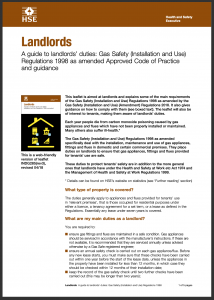
A guide to landlords’ duties: Gas Safety (Installation and Use) Regulations 1998 as amended Approved Code of Practice and guidance
This leaflet is aimed at landlords and explains some of the main requirements of the Gas Safety (Installation and Use) Regulations 1998 as amended by the Gas Safety (Installation and Use) (Amendment) Regulations 2018. It also gives guidance on how to comply with them (see boxed text). The leaflet will also be of interest to tenants, making them aware of landlords’ duties.
The Gas Safety (Installation and Use) Regulations 1998 as amended specifically deal with the installation, maintenance and use of gas appliances, fittings and flues in domestic and certain commercial premises. They place duties on landlords to ensure that gas appliances, fittings and flues provided for tenants’ use are safe.
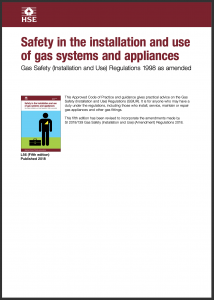
Safety in the installation and use of gas systems and appliances
This Approved Code of Practice and guidance gives practical advice on the Gas Safety (Installation and Use) Regulations (GSIUR). It is for anyone who may have a duty under the regulations, including those who install, service, maintain or repair gas appliances and other gas fittings.
This fifth edition has been revised to incorporate the amendments made by SI 2018/139 Gas Safety (Installation and Use) (Amendment) Regulations 2018.
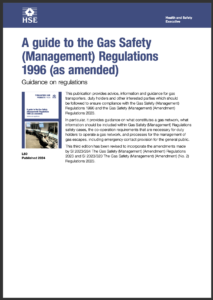
A guide to the Gas Safety (Management) Regulations 1996 (as amended)
This publication provides advice, information and guidance for gas transporters, duty holders and other interested parties which should be followed to ensure compliance with the Gas Safety (Management) Regulations 1996 and the Gas Safety (Management) (Amendment) Regulations 2023.
In particular, it provides guidance on what constitutes a gas network, what information should be included within Gas Safety (Management) Regulations safety cases, the co-operation requirements that are necessary for duty holders to operate a gas network, and processes for the management of gas escapes, including emergency contact provision for the general public.
This third edition has been revised to incorporate the amendments made by SI 2023/284 The Gas Safety (Management) (Amendment) Regulations 2023 and SI 2023/320 The Gas Safety (Management)(Amendment) (No. 2) Regulations 2023.
Gas industry unsafe situations procedure (Updated July 2025)
This Procedure supersedes 2nd Edition of IGEM/G/11 with amendments July 2022 and June 2024 The Gas Industry Unsafe Situations Procedure (GIUSP), which is obsolete.
This Procedure has been drafted by a Panel appointed by the Institution of Gas Engineers and Managers’ (IGEM’s) Technical Coordinating Committee, subsequently approved by that Committee; the Gas Utilisation Committee, the Gas Measurement Committee and the Gas Transmission and Distribution Committee and published by the authority of the Council of IGEM.
This Procedure is for use by Gas Safe registered businesses/engineers when dealing with unsafe situations in domestic and non-domestic premises supplied with Natural Gas, Liquefied Petroleum Gas (LPG) and Hydrogen as defined in the Gas Safety (Installation and Use) Regulations 1998.

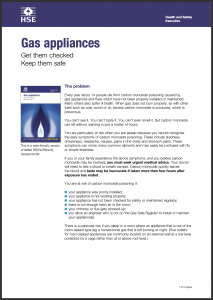
Gas appliances - Get them checked, Keep them safe
Every year about 14 people die from carbon monoxide poisoning caused by gas appliances and flues which have not been properly installed or maintained. Many others also suffer ill health. When gas does not burn properly, as with other fuels such as coal, wood or oil, excess carbon monoxide is produced, which is poisonous.
You can’t see it. You can’t taste it. You can’t even smell it. But carbon monoxide can kill without warning in just a matter of hours.
You are particularly at risk when you are asleep because you cannot recognise the early symptoms of carbon monoxide poisoning. These include tiredness, drowsiness, headache, nausea, pains in the chest and stomach pains. These symptoms can mimic many common ailments and may easily be confused with flu or simple tiredness.