Electrical Safety
Code of Practice for the Management of Electrotechnical Care in Social Housing
This Code of Practice (CoP) has been created by Social Housing professionals responsible for the management and maintenance of electrical installations in the sector. The purpose of this document is to offer a consistent recommended approach for how the safety of electrical installations in domestic tenanted properties can be continuously verified in the social housing sector within the United Kingdom. It also provides clarity to those managing electrotechnical care in domestic tenanted properties to ensure the decisions they make with regards to the points covered in this CoP are benchmarked across the industry and amongst its stakeholders.
Social Housing is a unique form of tenure which, although heavily regulated, does not currently have a sector-agreed standard for determining the continuous electrical safety of housing stock and assets. This CoP should be used to support the creation of an Electrical Safety Policy and procedure document, signed off by the Board or Cabinet.
Electrical Safety First - Best Practice Guide 4: Electrical installation condition reporting (EICR)
Whilst these best practice guides are not always aimed at social landlords, they contain useful information which we think is worth sharing with members.
The aim of this guide is to provide a practical guidance for skilled persons competent in electrical inspection and testing on the use of the Classification Codes that need to be attributed to each observation recorded during the periodic inspection and testing of an electrical installation for the benefit of the person ordering the report.
Although focused on the likely observations associated with domestic and similar electrical installations, this guidance can be applied to similar situations in other types of installation.
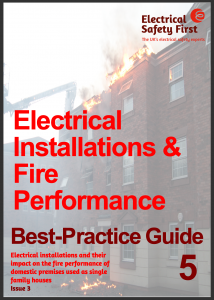
Electrical Safety First - Best Practice Guide 5: How electrical installations impact fire performance of domestic premises
Whilst these best practice guides are not always aimed at social landlords, they contain useful information which we think is worth sharing with members.
The aim of this guide is to promote best practice by providing practical advice and guidance for designers, installers, verifiers and inspectors of domestic electrical installations where the work penetrates linings forming ceilings and walls.
It addresses the impact of electrical installations on the fire performance of loadbearing and non-loadbearing walls and floors (and sometimes ceiling membranes) which have a fire containment function, and/or are required to carry a load for a prescribed period.
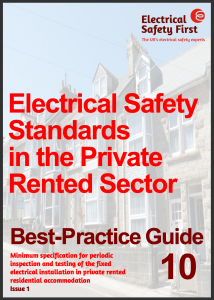
Electrical Safety First - Best Practice Guide 10: Electrical safety standards in private rented accommodation
Whilst these best practice guides are not always aimed at social landlords, they contain useful information which we think is worth sharing with members.
This guide is aimed at private landlords, letting agents, and others responsible for the upkeep and maintenance of the electrical installation in dwelling houses used as private rented residential accommodation, and for electricians carrying out periodic electrical inspection and testing in them.
It sets out the minimum recommended degree of periodic inspection and testing necessary to meet the requirements of relevant UK legislation, and to confirm – or not – that the electrical installation is safe for continued use.
Electrical Bicycles - Property Risk Management
Aviva have launched a loss prevention standard for anyone responsible for buildings where e-bikes may be stored.
The standard outlines the main risk exposures in the handling, charging and storage of e-bikes and provides general guidance to help reduce the potential for significant loss and impacts to business trading.