Guidance on Safe Investigation of Fire Alarm Signals in Scotland

In close collaboration with the Scottish Fire and Rescue Service (SFRS) and other health and safety experts, the Fire Industry Association (FIA) has published new guidance on the safe investigation of fire alarm signals in Scotland. It follows a recent decision by SFRS to stop attending automatic fire alarm (AFA) call outs to commercial business and workplace premises “unless a fire has been confirmed”. Instead, the service will adopt a “call challenge” policy, which will come into effect on 1 July.

In light of the changes, new guidance has been created to support nominated persons and dutyholders of commercial businesses and workplace premises and enable them to gain a clearer understanding of the approaches to avoiding risk. This includes the safe investigation of alarm signals and a checklist in which to monitor fire safety measures and practices. All of this aims to “assist dutyholders to investigate fire alarm signals at the premises prior to summoning the SFRS”.

As stated in the guidance document, “It is essential that, where, as part of fire procedures, it will be necessary for persons on the premises to investigate a fire alarm signal prior to summoning the SFRS, there are safe procedures to carry this out.”

SFRS is keen to reiterate that the changes to fire alarm response will not apply to sleeping premises such as care homes, hospitals, hotels, or domestic dwellings.

You can visit the FIA website here and read the guidance note here.
Do you manage care homes?

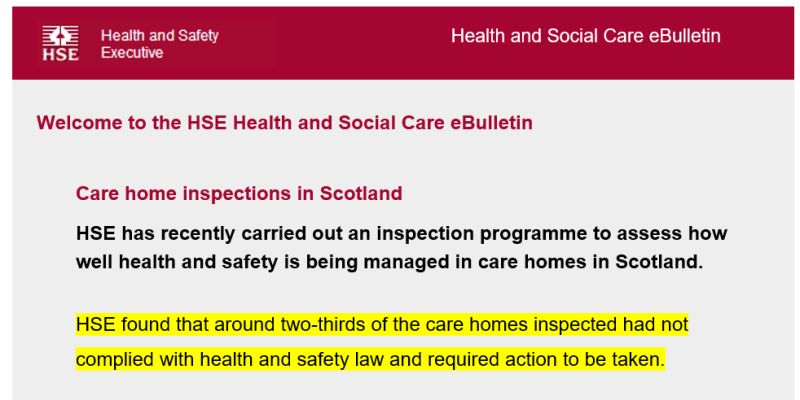
The HSE have recently been carrying out inspections to assess how well health and safety is being managed in care homes and they found that two thirds of those homes inspected had NOT complied with health and safety law and required action to be taken!

The common failings identified related to the following areas:

  • Scalding and hot surfaces
  • Legionella
  • Falls
  • Wandering
  • Lifting equipment
  • Chemicals and cleaning materials
  • Choking
  • Management arrangements

Where breaches of law were found during the inspections, measures were taken to ensure care home providers comply with law, including by taking enforcement action.

HSE’s website has guidance on health and safety in care homes, where you can find information on how to protect workers and service users from the risks mentioned above. In addition, the Scottish Government website sets out how care in Scotland is regulated.

LEIA Guidance Note: Checks and inspections of lifts for use by firefighters, evacuation lifts, and lifts with recall

The Lifts and Escalator Industry Association (LEIA) have put together this really useful guidance covering ‘Checks and inspections of lifts for use by firefighters, evacuation lifts, and lifts with recall’

If you have a lift in your building you'll find this very useful as it provides practical advice for lift owners/ responsible persons, competent persons undertaking a thorough examination and calling for any supplementary tests, and lift maintenance providers.

Lift owners/ responsible persons might find this guidance of use in fulfilling their duties under regulations such as The Regulatory Reform (Fire Safety) Order 2005 (RRO), The Fire Safety (Scotland) Regulations 2006 and The Fire Safety Regulations (Northern Ireland) 2010.

There’s also a section which helps you to identify the different lift types.

You can download the guide here – we hope you find it useful.

Housing Regulator publishes outcome of its annual risk assessment

The Scottish Housing Regulator (SHR) recently published the outcome of its annual risk assessment of all social landlords; the main areas it focussed on in its risk assessment this year were homelessness, tenant and resident safety, governance and financial wellbeing and it highlights some of the risks and challenges facing tenants and other service users.
One of the key strategic risk areas, highlighted in the report is tenant and resident safety which not only ensures that tenants live in warm, safe and dry homes but also includes stock quality and how landlords ensure homes are meeting the Scottish Housing Quality Standard (SHQS) alongside their statutory obligations on health and safety.
Gas safety remains an important focus, but consideration to compliance with new requirements in relation to electrical safety testing and the installation of linked heat and smoke detectors is also a key strategic risk.
During their assessment, SHR found that compliance with SHQS fell from 86% in 2020/21 to 72% in 2021/22. In the information submitted by landlords, SHR saw that most of the homes failing or in abeyance from SHQS appear to be because some landlords had yet to fully comply with new requirements on electrical safety inspections and installation of interlinked smoke and heat detectors – even though compliance was due in February 2022. Landlords must fully meet the requirements as a matter of urgency and should further ensure they have accurate data to help with monitoring and reporting compliance.
Damp and mould is in the spotlight and the SHR expects governing bodies and committees to consider the systems that they have in place to ensure that their tenants’ homes are not affected, and they have proactive systems to identify and deal with any reported cases of mould and damp timeously.
Read the full article here.

Putting safety first: a briefing note on damp and mould for social housing practitioners in Scotland

Four of Scotland’s leading housing organisations have jointly published a new guide on tackling damp and mould in the social housing sector.
ALACHO (Association of Local Authority Chief Housing Officers), CIH Scotland, the Scottish Federation of Housing Associations, and the Scottish Housing Regulator have worked together to provide the social housing sector with improved information on how they can respond to damp and mould.
Issues of damp and mould in homes are high on the agenda of social housing providers; if damp and mould are left untreated for long periods, health problems can be serious, or in extreme cases, fatal.
The briefing highlights that all housing professionals should understand the significance of damp and mould issues and have a general awareness of what it is, what causes it, and how to identify it.
Download the guide here.