Fire Safety
SFRS Advice on Fire Safety: Choosing a Competent Fire Risk Assessor
The responsibility to carry out an assessment of fire risk, review such an assessment and to take fire safety measures rests with duty holders. Duty holders, or their employees, may have the necessary training, skills, knowledge and experience to carry out their own fire safety risk assessment and guidance available on the Scottish Government website may be of assistance.
Duty holders must consider their own capabilities, circumstances, and factors such as the size and use of premises and number of persons, in respect of the fire safety risk assessment process. Whilst duty holders are often best placed to know their premises, they may not have sufficient resources, skills or experience to undertake a fire safety risk assessment themselves and can arrange for a suitably qualified or competent person or company to complete an assessment on their behalf.
This advice is provided to help Duty holders decide who should undertake a fire risk assessment so their premises comply with the applicable fire safety legislation in Scotland, namely the Fire (Scotland Act) 2005 and the Fire Safety (Scotland) Regulations 2006.
Guidance on Safe Investigation of Fire Alarm Signals in Scotland
As a result of the continuing high rate of false alarms from fire detection and alarm systems, throughout Scotland, the Scottish Fire and Rescue Service (SFRS) now adopt a ‘call challenge’ policy in relation to calls arising from the operation of an automatic fire alarm system (whether received via an emergency 999 call or from an alarm receiving centre, (ARC)).
Accordingly, depending on circumstances, there will be situations in which the SFRS will not dispatch fire appliances on receipt of a call arising from operation of a fire alarm system unless it can be confirmed by the caller that there is a fire or signs indicative of a fire. In some circumstances, there will be an attendance, but the number of appliances dispatched may be reduced unless, or until, a fire is confirmed.
This has become necessary because the current level of unwanted fire alarm signals (UFAS) to which SFRS are summoned cannot be sustained. Equally, investigation of circumstances in which a fire alarm is activated must be carried out safely. The objective of this guidance document is to assist dutyholders to investigate fire alarm signals at the premises prior to summoning the SFRS.
Practical fire safety guidance for existing care homes
In 2006, the Fire (Scotland) Act 2005 (the ‘2005 Act') introduced changes to fire safety law in Scotland and repealed previous fire safety legislation. This guide has been produced to assist those who have responsibility under this Act for ensuring fire safety in care homes in Scotland. In addition, this guide provides statutory guidance for the Scottish Fire and Rescue Service (‘SFRS’), as an enforcing authority.
Reducing the risk from fire is an important and fundamental duty in a care home. Fatalities have occurred in fires in premises providing residential care, most notably the fire at Rosepark Care Home in 2004, when a short, rapidly developing fire originated in a cupboard in a bedroom corridor. Inhalation of smoke and toxic gases claimed the lives of 14 residents. This demonstrates the serious risk that fire poses to the occupants of care homes, the tragic consequences which may occur, and the importance of management of fire safety.
This Scottish Government guidance provides practical fire safety advice for care homes. It supersedes the previous February 2014 version.
Practical fire safety guidance for existing high rise domestic buildings
This guidance provides practical fire safety advice on how to prevent fires and reduce the risks from fires in high rise domestic buildings. It aims to assist the assessment of fire risk and the adequacy of existing fire safety measures. The focus is on communal areas and aspects of building design in private accommodation which could affect the safety of others.
This guidance applies only to Scotland and is not mandatory. Given building design varies no single guidance can provide specific solutions for all possible circumstances.
The guidance aims to reduce the risk to life from fire. As such, the focus is on life safety rather than the protection of property.
Practical fire safety guidance for existing non-residential premises
In 2006, the Fire (Scotland) Act 2005 (“the 2005 Act”) introduced changes to fire safety law in Scotland and repealed previous fire safety legislation. This guide has been produced to assist those who have responsibility under this Act for ensuring fire safety in non-residential premises in Scotland. In addition, the guide has a statutory basis for the Scottish Fire and Rescue Service (“SFRS”) and local authorities, as enforcers.
This Scottish Government guidance provides practical fire safety advice for existing non-residential premises. It supersedes the previous 2017 version.
Practical fire safety guidance for existing premises with sleeping accommodation
In 2006, the Fire (Scotland) Act 2005 (‘the 2005 Act’) introduced changes to fire safety law in Scotland and repealed previous fire safety legislation. This guide has been produced to assist those who have responsibility under this Act for ensuring fire safety in certain premises with sleeping accommodation in Scotland. In addition, this guide provides statutory guidance for the Scottish Fire and Rescue Service (‘SFRS’), as an enforcing authority.
This Scottish Government guidance provides practical fire safety advice for certain existing premises with sleeping accommodation. It supersedes the previous June 2018 version.
Practical fire safety guidance for existing specialised housing and similar premises
This guidance is primarily for those who are responsible for specialised housing and similar premises and for those who provide care and support services in such premises. It provides practical fire safety advice on how to prevent and reduce the risk to life from fire. As such, the focus is on life safety rather than property protection.
Its purpose is to strengthen fire safety for people who receive care or support in specialised housing or similar premises. It will also be useful for those receiving “care at home” services or support in “general needs” housing.
Building Regulations ensure a basic level of fire safety in premises. This should be supplemented by an assessment of fire risk to determine whether existing measures are appropriate or if more needs to be done. This Guidance supports that process.
Sprinkler Protected Buildings : A Guide for Responsible Persons and Duty Holders
The British Automatic Fire Sprinkler Association (BAFSA) have launched a guide to help responsible persons and duty holders of sprinkler protected buildings
The freely available publication, entitled Sprinkler Protected Buildings: A Guide for Responsible Persons and Duty Holders, summarises the main obligations imposed on the owner or occupier of a building or structure fitted with a sprinkler or water mist system.
Outlining the duties laid out in legislation, the guide also covers details around using third-party certified systems and installers, the proper maintenance of fire suppression systems, and the different requirements between residential/domestic systems and industrial/commercial systems. It also provides details on water mist systems, what a responsible person must do in the event that a fire suppression system becomes non-operational, and how to minimise water damage.
Fire precautions log book
This fire safety log book and maintenance record should remain on the premises at all times. The register will assist you in proving compliance with your legal responsibilities in relation to fire safety and should be completed following the inspection, test and maintenance of any of the items required by the legislation.
The log book should be available for inspection by any Fire Officer who inspects your premises under the Fire (Scotland) Act 2005.
Detailed information in relation to the testing and maintenance of specific items can be obtained by referring to the relevant standard and/or the manufacturers’ instructions.
Practical fire safety guidance: The evacuation of disabled persons from buildings
We all know that in the event of fire, dialling 999 will summon the Fire and Rescue Service. While the Fire and Rescue Service is responsible for fighting fires and protecting life and property in the event of fire, we all have a role to play in minimising the risk from fire, but if one does start, we all want to know that we can escape from premises safely.
Under fire safety legislation in Scotland, it is the responsibility of those persons who have control of, or safety obligations in respect of non- domestic premises, to ensure that arrangements are in place for an evacuation of the premises, if the situation requires it. This responsibility cannot be delegated to the Fire and Rescue Service. Each building should have an emergency fire action plan specifying the evacuation procedures for everyone, including disabled people, likely to be in the building.
This document provides information and guidance on fire evacuation of disabled persons from buildings and will assist employers, organisations and fire safety enforcing authorities to consider disabled persons in a positive way and to deal with their evacuation in a practical, equality based manner.

Scottish Advice Note: Determining the fire risk posed by external wall systems in existing multi-storey residential buildings
The purpose of this Advice Note is to assist in determining the fire risk posed by external wall systems in existing multi-storey residential buildings. This will require a fire safety risk assessment and an appraisal of the external wall system which may include an intrusive investigation.
The aim of both are to ensure that people are not placed at undue risk of harm as a result of fire spread over or within the external wall system.
This Advice Note is concerned with life safety.
For the purpose of this Advice Note, an external wall system includes the outer cladding, cavity/fire barriers, insulation material behind the outer cladding, spandrel panels, window infill panels, balconies, solar shading and any other architectural feature or attachment to the building structure.. The main body of this Note deals with cladding systems and Annex 1 contains information on other external wall system features.
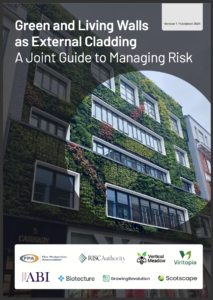
Green and Living Walls as External Cladding A Joint Guide to Managing Risk
A new joint guide has been published that considers the potential risks associated with green and living walls as external cladding if incorrectly designed or managed.
With green and living walls becoming a familiar feature of the built environment, the document, entitled Green and Living Walls as External Cladding – A Joint Guide to Managing Risk, seeks to consider the “implications that the provision of living walls may have for the resilience of the building, and the continuity of business or provision of services that are provided from it”.
In particular, it addresses those risks relating to fire, escape of water (EoW), and weather events. As the document states: “Many Living Walls are of a scale and location that presents no additional risk to the scenario that would warrant further consideration, but others, applied at larger scale to a building, might have the potential to exert great influence on the safety and insurability of that building – and others around it – if not properly designed and maintained.”
Produced collaboratively between key living wall providers and UK insurers through the FPA’s RISCAuthority research scheme, the guide has already been endorsed and supported by several organisations, including Vertical Meadow, Viritopia, ABI, Biotecture, Growing Revolution, and Scotscape.